 Martinez Tracy
Speech therapists know that language development does not happen only at a desk or in a therapy room. It happens in kitchens, in parks, in the back seat of a car, in the middle of an experience that is interesting enough to generate the questions, the naming, the narrating, and the retelling that language is built from. The richer and more novel the experience, the more language it tends to produce. Children who are working on their expressive vocabulary, their sentence structure, their sequencing and narrative skills, and their pragmatic use of language, all benefit from being placed in environments that give them something worth talking about.
An Oahu boat tour is that kind of environment, amplified. The Pacific Ocean around Hawaii is one of the most sensory-rich, biologically diverse, and visually compelling environments accessible to a family on a day trip. A morning on the water around Oahu produces spinner dolphin sightings, humpback whale encounters in season, sea turtle surfacing moments, the physical sensation of the boat’s motion in the swell, the smell of the ocean, the sound of the water, and the spatial experience of being surrounded by something vast and alive. For children at any stage of speech and language development, this is not entertainment. It is a structured opportunity for the kind of multi-sensory, socially embedded language use that therapy is designed to support.
Here are eight reasons the experience matters developmentally.
1. The Boat’s Motion Provides Vestibular Stimulation That Supports Neurological Readiness
Vestibular input, the sensory information the brain receives from the inner ear about motion, position, and balance, is one of the foundational sensory systems that influences a child’s capacity for attention, arousal regulation, and language processing. Children who are under-responsive to vestibular input often seek movement and may struggle to regulate their attention in static environments. Children who are over-responsive may find movement environments challenging but benefit from gradual, supported exposure.
The motion of a boat in ocean swell is a continuous source of vestibular input across a range of intensities: the gentle roll on calm water, the lift and drop across a wake, the lateral lean on a turn. This input is irregular enough to keep the vestibular system engaged but predictable enough to allow adaptation. For children whose sensory processing profiles include vestibular seeking or difficulties with arousal regulation, a well-managed boat experience provides the kind of whole-body movement input that can support the neurological state in which language production and social engagement come more easily. The connection between vestibular function and language readiness is one of the threads running through sensory integration research, as our piece on understanding sensory integration covers in more detail.
2. Naming What You See Is One of the Most Natural Vocabulary Exercises Available
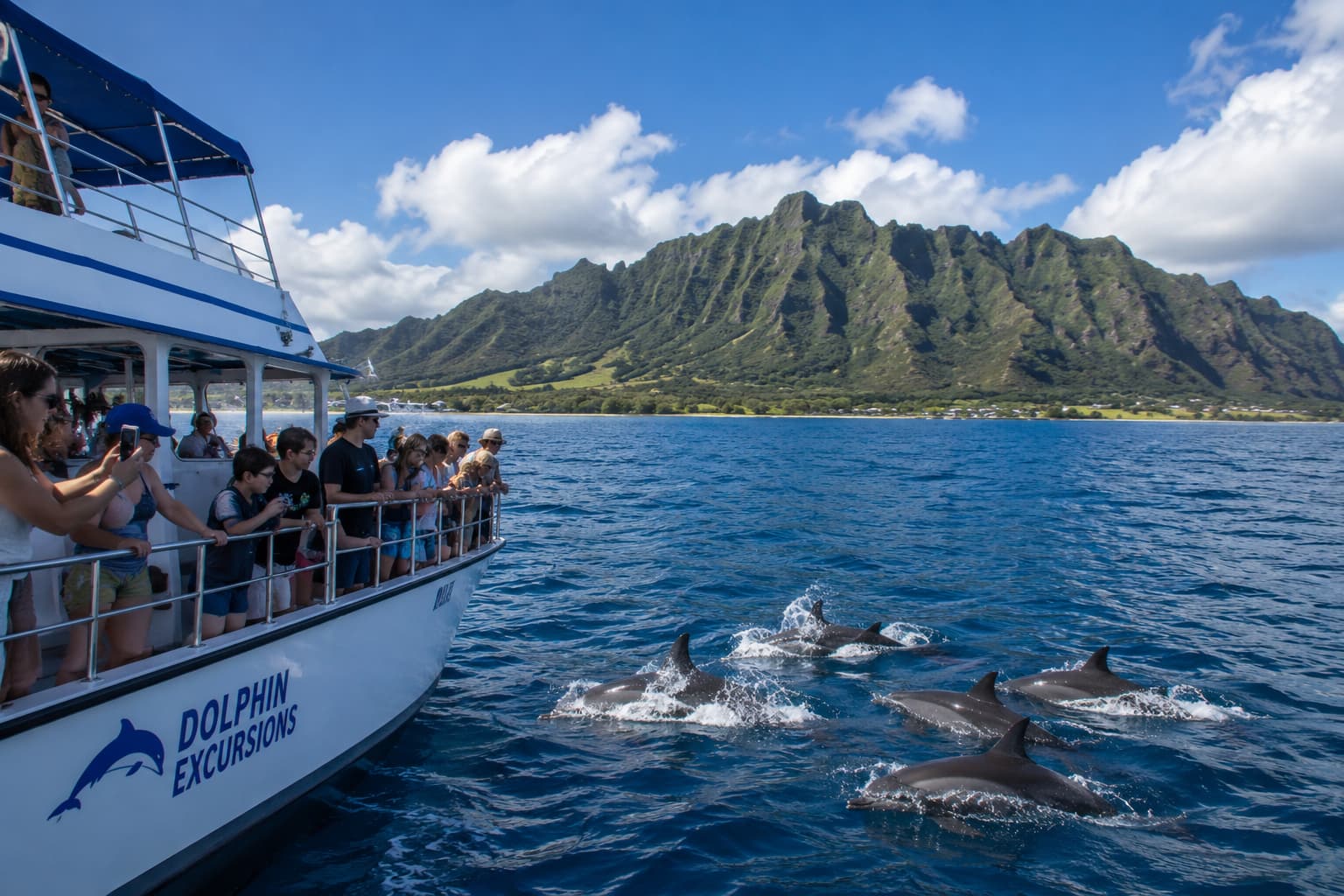
The ocean around Oahu presents a continuous vocabulary opportunity. Spinner dolphins are named for the spinning jumps they perform at the surface, and watching a pod spin and breach gives a child something specific and dynamic to name, describe, and question. Humpback whales, present in Hawaiian waters between November and May, surface with a visible blow, a tail fluke, and sometimes a full breach that demands description. Sea turtles, green turtles especially, are common around the reef areas accessible by boat and tend to surface at close range.
Each of these encounters naturally produces the naming, attribute description, and action sequencing that speech therapists build vocabulary exercises around. “The dolphin jumped and spun.” “The whale’s tail went into the water.” “The turtle has a spotted shell.” These are not artificial drill sentences. They are descriptions of real events that the child observed and wants to communicate, which is the motivational context in which new vocabulary is most likely to consolidate into retained, usable language.
3. Sequencing the Experience Builds Narrative Language Skills
One of the core targets in speech-language intervention for school-age children is narrative competence: the ability to tell a story with a beginning, a middle, and an end, with causal connections between events, and with enough specificity that a listener who was not present can follow what happened. This is a skill that many children with language delays find challenging, and it is one of the strongest predictors of later reading comprehension and academic performance.
A boat tour is a naturally sequenced experience with a clear narrative structure: you leave the harbour, you travel to the dolphin grounds, the dolphins appear, something specific happens, the boat moves to another site, and eventually you return. That structure gives a child with developing narrative skills a scaffold to work with when retelling the experience to a parent, a sibling, or a therapist. “First we got on the boat. Then we went far out. Then the dolphins came and one jumped right next to us.” The experience provides the content. The retelling is the practice.
4. The Shared Experience Creates Sustained Social Communication Opportunities
Pragmatic language, the social use of language to communicate with others in context, is a target area for many children in speech therapy. Commenting on what someone else has noticed, asking for clarification, directing another person’s attention, expressing shared excitement, and responding to another person’s comment are all pragmatic skills that require a real social context to practice meaningfully. You cannot practise joint attention in isolation.
A boat tour creates a sustained social communication environment: the child and the adults around them are all looking at the same things, responding to the same events, and have a shared reference point for the entire duration of the experience. “Did you see that?” is a bid for joint attention. “It went that way” is directional communication. “That was the biggest one yet” is a comparative comment within a shared context. Each of these is a pragmatic skill in action, embedded in a situation where it is motivated and natural rather than instructed and artificial.
5. The Multi-Sensory Environment Supports Integration Across Sensory Channels
The ocean environment engages every sensory modality simultaneously: the visual richness of the water surface, the horizon, and the marine life; the proprioceptive and vestibular input of the boat’s motion; the tactile sensation of spray, wind, and the boat’s surfaces; the olfactory input of salt air and ocean; and the auditory environment of water, wind, and the guide’s narration. For children who are working on multi-sensory integration, this environment provides the simultaneous cross-modal input that integration exercises are designed to produce, in a context where the integration is motivated by real experience rather than therapeutic task.
The neurological processes that underlie sensory integration, and their connection to language and communication development, are covered in detail in our piece on neurological rehabilitation and recovery pathways. The principle that applies directly here is that multi-sensory experiences in novel environments tend to produce higher levels of neurological engagement than single-modality experiences in familiar ones, and that this engagement supports the consolidation of new learning, including new language.
h2 6. Guided Boat Tours Provide the Narration That Structures the Child’s Experience
One of the advantages of a guided tour over unstructured time on the water is the guide’s narration. A skilled boat tour guide provides a running commentary on what they are observing: where the dolphins have been spotted, what the whale’s behaviour indicates, what species of sea turtle is surfacing and how to identify it, what the reef below the boat contains and how deep it is. This narration provides children with the language model, the vocabulary, and the descriptive framework for what they are experiencing, which is the input side of the language learning equation.
Operators like Oahu Boat Tours run guided ocean excursions around the island with naturalist guides who narrate the marine encounters, explain the ecology of the surrounding ocean, and answer questions from passengers throughout the trip. For families with children who are working on language development, this kind of guided, narrated experience provides exactly the structured input in a rich context that supports both vocabulary acquisition and the development of more complex descriptive language.
7. The Experience Provides Rich Material for Post-Trip Language Activities
The value of a sensory-rich shared experience for language development does not end when the boat returns to the harbour. The retelling, the drawing, the writing, and the showing-to-others that follow an experience like an Oahu boat tour extend the language opportunity across days and weeks. A child who is working on expressive vocabulary will use new words from the experience in the retelling. A child working on narrative structure will practise the sequencing. A child working on descriptive language will attempt to communicate the visual and sensory details to someone who was not there.
Speech therapists who work with children on narrative and expressive language skills often use “shared experience narratives” as a therapeutic structure: a child and a communication partner have an experience together, then the child retells it to a third party who was not present. The boat tour fits this structure with content that is motivating enough to sustain the child’s engagement in the retelling even when the retelling itself is effortful. A child who struggled to describe a park visit in three sentences may find considerably more to say about the dolphin that jumped right next to the boat.
8. Humpback Whale Season Creates a Once-in-a-Year Language Event
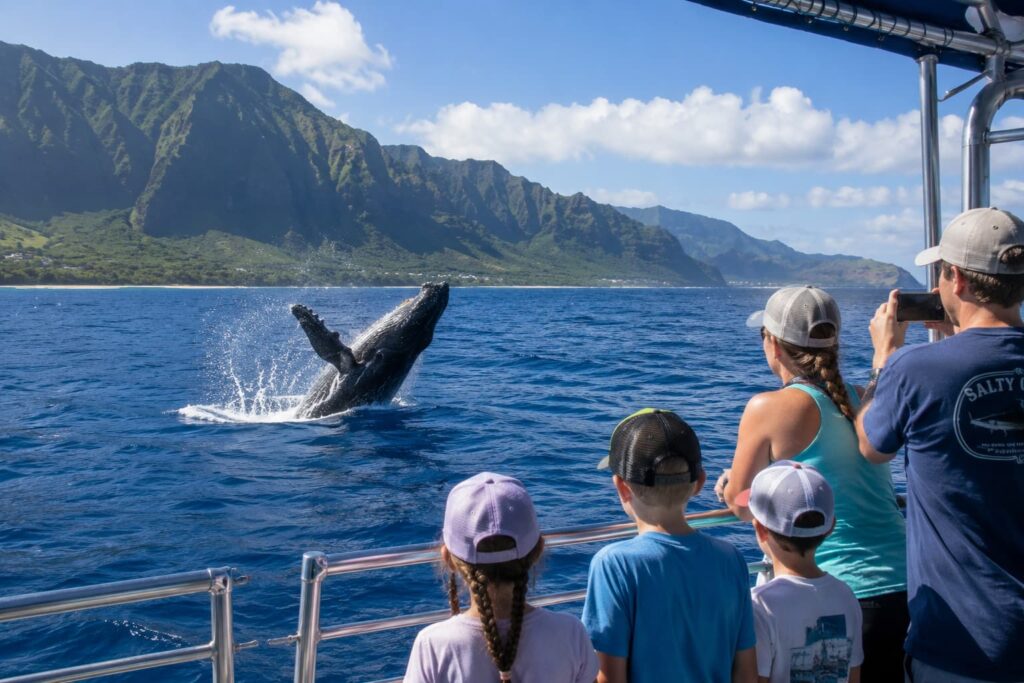
Humpback whales migrate to Hawaiian waters between November and May to breed and calve, and the waters around Oahu during this period contain one of the highest concentrations of humpbacks accessible by day boat from any North American city. A whale watching experience of this quality is not available from the mainland, and the specific nature of what a humpback whale does at the surface, the blow, the pectoral fin slap, the tail fluke raised before a dive, the full breach where the entire animal leaves the water, gives a child a vocabulary of specific events that is unlike anything in their ordinary environment.
The research on vocabulary acquisition consistently shows that words learned in the context of a distinctive, emotionally engaged experience are retained more durably than words introduced through repetition in a neutral context. A child who sees a humpback whale breach ten metres from the boat has the neural encoding of that experience as the semantic anchor for every whale-related word they acquire in that moment. “Breach.” “Fluke.” “Blow.” “Calf.” These are not arbitrary vocabulary items anymore. They are words attached to one of the most striking things the child has ever seen. That is how durable vocabulary is built.
A Final Thought
Speech and language development happens in the context of life, not despite it. The experiences that children have, the things they see and touch and wonder about and want to describe, are the raw material of their language growth. A speech therapist’s job is partly to create structured opportunities for that growth in the clinic, and partly to help families understand how to extend those opportunities into the wider world.
An Oahu boat tour is one of the widest of those opportunities: a multi-sensory, socially embedded, narrative-rich, vestibularly engaging, biologically astonishing morning that gives a child something to talk about for weeks. The whale did not breach for the sake of anyone’s language development. But the language development happens anyway, because that is what language does when something extraordinary enough has occurred that the child cannot help but try to put it into words.
That is the whole point.